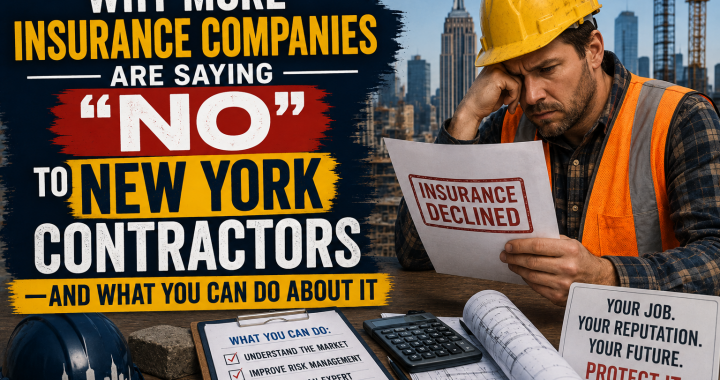
If you’ve recently received a non-renewal notice, seen your insurance premiums increase dramatically, or struggled to find coverage for your construction business, you’re not alone.
Across New York, contractors are experiencing one of the most challenging insurance markets in decades. Many insurance companies have either significantly reduced their appetite for construction risks or exited the market entirely. As a result, contractors who once had multiple insurance options are finding fewer carriers willing to write their business.
The good news? There are steps you can take to make your company more attractive to insurance companies and position yourself for better coverage and pricing.
Why Is the Insurance Market So Difficult?
The construction industry has always presented challenges for insurance carriers, but several factors have combined to make New York one of the toughest insurance markets in the country.
Insurance companies have experienced rising claim costs, larger jury verdicts, increased litigation, higher medical expenses, and inflation affecting repair and reconstruction costs. In New York, Labor Law claims involving gravity-related injuries have added another layer of exposure that many insurance companies view as particularly difficult to insure.
As claims become more severe, insurance companies respond by tightening underwriting guidelines, increasing premiums, limiting coverage, or deciding to stop writing certain classes of contractors altogether.
The result is a marketplace where fewer companies are competing for construction business.
Contractors Are Seeing the Effects
Many contractors who have maintained clean loss histories are surprised when they receive renewal terms that include:
- Significant premium increases
- Higher deductibles
- Reduced coverage
- New exclusions
- More restrictive endorsements
- Non-renewal notices
In many cases, these changes are driven by overall market conditions rather than the individual contractor’s performance.
That can be frustrating, but it also means contractors must be proactive in presenting their business in the best possible light.
Google Search #1: “New York contractor insurance”
One of the most common phrases contractors type into Google is “New York contractor insurance.”
Unfortunately, finding insurance isn’t as simple as filling out an online form.
Construction insurance is highly specialized. Two contractors performing similar work may receive completely different pricing and coverage depending on factors such as:
- Years in business
- Payroll
- Subcontracted operations
- Types of projects
- Annual receipts
- Claims history
- Safety programs
- Geographic territory
- Employee experience
- Types of contracts performed
Insurance companies evaluate each business differently, making it important to work with someone who understands how underwriters assess construction risks.
Labor Law Continues to Influence Underwriting
New York Labor Law remains one of the biggest concerns for insurance carriers.
Claims involving falls from ladders, scaffolding, roofs, and elevated work areas can result in substantial settlements and judgments.
Because of this exposure, some insurance companies have:
- Eliminated certain contractor classes
- Added Labor Law exclusions
- Limited residential construction
- Reduced acceptable project sizes
- Increased minimum premiums
Understanding these underwriting concerns can help contractors better prepare when applying for coverage.
Google Search #2: “Best insurance for contractors in NY”
Another frequently searched phrase is “best insurance for contractors in NY.”
The answer depends entirely on your business.
There is no single insurance company that is the best fit for every contractor.
Instead, the right carrier depends on your:
- Trade classification
- Annual revenue
- Experience
- Safety record
- Types of work performed
- Percentage of subcontracted work
- Desired coverage options
The goal shouldn’t simply be finding the lowest premium.
The goal should be finding the insurance program that provides appropriate protection while remaining competitive.
A policy with hidden exclusions may save money today but create enormous financial exposure after an accident.
Safety Matters More Than Ever
Insurance companies increasingly want evidence that contractors actively manage safety.
Examples include:
- Written safety manuals
- Toolbox meetings
- Fall protection training
- Drug-free workplace programs
- OSHA compliance
- Employee orientation
- Supervisor training
- Equipment inspections
A strong safety culture reduces accidents and demonstrates to underwriters that your company takes risk management seriously.
That can improve your company’s attractiveness to insurance carriers.
Financial Stability Makes a Difference
Insurance companies also consider financial responsibility.
Underwriters often review:
- Years in business
- Business experience
- Financial stability
- Credit history (where permitted)
- Consistency of operations
Companies that demonstrate long-term stability generally receive more favorable consideration than newer businesses with limited operating history.
Google Search #3: “Contractor liability insurance New York”
A third popular search phrase is “contractor liability insurance New York.”
Many contractors searching this phrase are surprised to learn that General Liability insurance alone is only one part of a comprehensive insurance program.
Depending on your operations, you may also need:
- Workers’ Compensation
- Commercial Auto
- Inland Marine
- Builder’s Risk
- Commercial Property
- Umbrella Liability
- Professional Liability
- Pollution Liability
- Cyber Liability
Every construction business has unique exposures, making it important to evaluate the complete picture rather than purchasing only the minimum required coverage.
Your Application Matters
One of the most overlooked aspects of obtaining insurance is the quality of the application submitted to the insurance company.
An incomplete or poorly prepared submission may delay underwriting—or even result in a declination.
A strong submission typically includes:
- Detailed operations descriptions
- Updated loss runs
- Payroll information
- Revenue by trade
- Safety procedures
- Project photographs
- Website information
- Copies of contracts when requested
The more confidence an underwriter has in your business, the more likely they are to offer favorable terms.
Don’t Wait Until the Last Minute
Many contractors begin shopping for insurance only a few weeks before renewal.
That leaves little time to:
- Market the account
- Negotiate terms
- Obtain competing quotations
- Address underwriting questions
- Correct inaccurate information
Beginning the renewal process 60 to 90 days before expiration provides significantly more flexibility.
It also allows your insurance advisor time to present your company effectively to multiple insurance markets.
Relationships Matter
The insurance marketplace has become increasingly relationship-driven.
Experienced brokers who regularly work with construction insurance often know which carriers are actively seeking certain contractor classes and which companies have recently tightened underwriting.
They also understand how to present your business in a way that highlights strengths rather than simply submitting an application.
That experience can make a meaningful difference when insurance companies are deciding whether to quote your account.
The Bottom Line
Although today’s construction insurance market is challenging, contractors are not powerless.
By maintaining strong safety practices, keeping accurate financial records, preparing professional insurance submissions, and working with an experienced construction insurance specialist, you can improve your chances of obtaining quality coverage at competitive pricing.
Insurance companies want to insure well-managed contractors. The better your business is presented, the better your opportunities become.
How BGES Group Can Help
At BGES Group, construction insurance isn’t just one of the services we offer—it’s one of our specialties. We understand the challenges New York contractors face because we’ve been helping contractors navigate the insurance marketplace for more than 45 years.
We work with a broad network of highly rated insurance companies that understand the construction industry. Whether you’re a general contractor, subcontractor, artisan contractor, or specialty trade, we take the time to understand your business, review your current insurance program, identify coverage gaps, explain exclusions, and market your account to insurance companies that are the best fit for your operations.
Our goal is to provide more than just an insurance policy. We strive to become a trusted advisor who helps protect your business, keeps you compliant with contractual insurance requirements, and positions you for long-term success.
If your current insurance company has declined to renew your policy, added restrictive exclusions, or significantly increased your premium, we’d welcome the opportunity to provide a second opinion.
Contact Information
Gary Wallach
BGES Group
📞 914-806-5853
📧 bgesgroup@gmail.com
🌐 www.bgesgroup.com
Disclaimer: This article is provided for general educational and informational purposes only and should not be considered legal, insurance, or financial advice. Insurance coverage, premiums, underwriting decisions, policy terms, endorsements, and exclusions vary by insurance carrier and individual circumstances. Contractors should consult with a qualified insurance professional regarding their specific insurance needs before making coverage decisions.