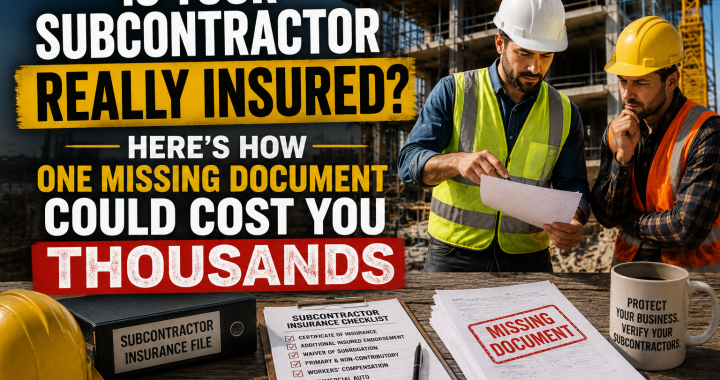
Subcontractors play a vital role in the construction industry. Whether you’re a general contractor managing a large commercial project or a specialty contractor bringing in additional help, subcontracting work is often essential to completing projects on time and within budget.
But here’s a question every contractor should ask:
Is your subcontractor actually insured—or do you simply have a Certificate of Insurance sitting in a file?
Unfortunately, many New York contractors believe collecting a Certificate of Insurance (COI) is enough to protect them. In reality, one missing endorsement or improperly executed agreement could leave your company responsible for claims you thought someone else’s insurance would cover.
In today’s construction environment, proper subcontractor insurance management isn’t just a good business practice—it’s an essential part of protecting your company’s financial future.
Why This Matters More Than Ever
Insurance companies have become much stricter about subcontractor risk.
Claims involving uninsured or underinsured subcontractors continue to increase, and many insurance carriers have responded by adding subcontractor warranty endorsements that require contractors to follow specific insurance procedures.
If those procedures aren’t followed, coverage may be reduced—or, in some cases, denied.
That’s a costly surprise no contractor wants after an accident.
Google Search #1: “Contractor liability insurance New York”
One of the most common searches contractors perform is “contractor liability insurance New York.”
What many business owners don’t realize is that your General Liability policy may assume you’ve properly transferred risk to your subcontractors.
If you haven’t, your own insurance company could end up paying claims that should have been covered by the subcontractor’s policy.
Even worse, your future premiums could increase because of claims that weren’t entirely your fault.
A Certificate of Insurance Isn’t the Whole Story
Certificates of Insurance are important.
However, they are only evidence that coverage existed on the date the certificate was issued.
A certificate does not:
- Change the policy
- Add coverage
- Guarantee policy language
- Confirm required endorsements exist
- Create contractual rights
Many contractors mistakenly stop their review after receiving the certificate.
That’s where problems begin.
The Documents Every Contractor Should Collect
Every subcontractor should ideally provide more than just a Certificate of Insurance.
A complete insurance package should include:
- Current Certificate of Insurance
- Additional Insured endorsement
- Primary and Non-Contributory endorsement
- Waiver of Subrogation endorsement
- Workers’ Compensation certificate
- Employer’s Liability coverage
- Commercial Auto coverage (when applicable)
- Umbrella or Excess Liability policy (when required)
- Written Insurance and Hold Harmless Agreement
- Current insurance carrier information
Collecting these documents before work begins can significantly reduce future disputes.

Don’t Forget the Written Contract
One of the biggest mistakes contractors make is relying on verbal agreements.
Every subcontractor relationship should include a written subcontract agreement that clearly outlines insurance requirements.
The agreement should specify:
- Minimum liability limits
- Required endorsements
- Additional Insured obligations
- Hold Harmless language
- Indemnification provisions
- Workers’ Compensation requirements
- Safety expectations
- Certificate renewal requirements
Without a written agreement, enforcing insurance requirements becomes much more difficult.
Google Search #2: “Additional insured endorsement”
Another frequently searched phrase is “Additional insured endorsement.”
This endorsement is one of the most important documents in construction insurance.
Being named as an Additional Insured may provide your company with protection under the subcontractor’s liability policy for certain claims arising from their work.
However, not all Additional Insured endorsements are the same.
Some apply only during ongoing operations.
Others extend to completed operations.
Some automatically provide coverage when required by written contract.
Others require scheduled endorsements.
Reviewing the actual endorsement—not simply the Certificate of Insurance—is critical.
Verify Coverage Every Year
Many contractors collect insurance certificates once and never review them again.
That’s risky.
Policies expire.
Insurance companies change.
Coverage limits change.
Businesses cancel insurance.
Certificates should be updated before expiration and reviewed annually to ensure coverage remains in force throughout the project.
A certificate that expired six months ago provides very little protection today.
Workers’ Compensation Matters
Workers’ Compensation is another area that deserves close attention.
If a subcontractor fails to maintain Workers’ Compensation coverage and one of their employees is injured, your company could become involved in expensive legal and insurance issues.
Always verify:
- Current Workers’ Compensation policy
- Correct legal entity
- Active policy dates
- Appropriate state coverage
- Employer’s Liability limits
Never assume coverage exists simply because the subcontractor tells you it does.
Umbrella Coverage May Be Required
Many commercial projects require subcontractors to carry Umbrella or Excess Liability insurance.
If your contract requires $5 million in liability protection but your subcontractor only carries $1 million, your risk transfer strategy may fall short.
Review contract requirements carefully and verify that required limits are actually in place.
Google Search #3: “Best insurance for contractors in NY”
Many contractors searching “best insurance for contractors in NY” are actually looking for guidance—not just an insurance policy.
The best insurance program isn’t necessarily the cheapest.
It’s the one that helps protect your business from the unexpected.
Part of that protection includes helping contractors develop procedures for reviewing subcontractor insurance before problems arise.
Insurance should work alongside strong risk management practices—not replace them.
Develop a Simple Review Process
Every contractor should establish a standardized subcontractor insurance review process.
Before work begins:
✓ Obtain the Certificate of Insurance.
✓ Review the Additional Insured endorsement.
✓ Verify Primary and Non-Contributory wording.
✓ Confirm Waiver of Subrogation.
✓ Review liability limits.
✓ Verify Workers’ Compensation.
✓ Obtain a signed Hold Harmless Agreement.
✓ Calendar certificate expiration dates.
✓ Maintain organized electronic records.
This simple checklist can prevent major problems later.
Your Reputation Is Also at Stake
Insurance isn’t just about paying claims.
It’s also about professionalism.
General contractors appreciate subcontractors who provide complete insurance documentation quickly and accurately.
Likewise, project owners prefer contractors who actively manage their subcontractor insurance compliance.
Strong documentation demonstrates organization, responsibility, and attention to detail.
Those qualities often lead to repeat business and stronger client relationships.
Prevention Is Always Less Expensive Than Litigation
One missing endorsement can result in months—or years—of litigation.
Spending a few extra minutes reviewing insurance documents before work begins is far less expensive than defending a lawsuit after an accident.
Risk management isn’t about expecting problems.
It’s about being prepared if they occur.
How BGES Group Can Help
At BGES Group, we specialize in insurance solutions for New York contractors and understand the unique challenges of managing subcontractor risk. With more than 45 years of experience in the insurance industry, we’ve helped contractors navigate increasingly complex insurance requirements while protecting their businesses from costly coverage gaps.
We don’t simply sell insurance—we partner with our clients to review contracts, explain endorsements in plain English, identify hidden exclusions, and help ensure that both your insurance program and your subcontractor insurance procedures are aligned with today’s construction industry standards.
Whether you need Commercial General Liability, Workers’ Compensation, Commercial Auto, Inland Marine, Umbrella Liability, Builder’s Risk, or guidance on subcontractor insurance compliance, BGES Group is committed to helping your business stay protected and competitive.
If you’d like a second opinion on your current insurance program or want help developing a subcontractor insurance compliance process, we’d be happy to assist.
Contact Information
Contact – Gary Wallach
📞 914-806-5853
Disclaimer: This article is provided for general informational and educational purposes only and should not be considered legal or insurance advice. Insurance coverage depends on the specific policy language, endorsements, exclusions, underwriting guidelines, and the facts of each individual claim. Contractors should consult with a qualified insurance professional and legal counsel regarding their specific contractual obligations and insurance requirements.