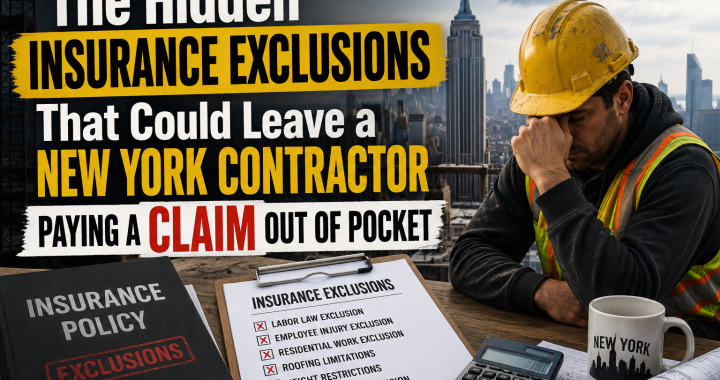
Most contractors believe that if they purchase a Commercial General Liability (CGL) policy, they are protected. Unfortunately, that assumption can be a costly mistake.
In today’s New York construction insurance market, many policies contain exclusions and restrictive endorsements that can dramatically reduce coverage. The unfortunate reality is that many contractors do not discover these limitations until after an accident occurs—when it is far too late to correct the problem.
If you own a construction company in New York, understanding the exclusions buried inside your insurance policy may be just as important as understanding the coverage itself.
The Lowest Premium Isn’t Always the Best Value
Insurance shopping often becomes a race to find the lowest premium. While everyone wants to save money, choosing a policy based solely on price can expose your business to financial disaster.
Some insurance companies reduce premiums by adding endorsements that eliminate coverage for common construction exposures. At first glance, the declarations page may look similar to a more comprehensive policy, but the policy language tells a very different story.
Before accepting the lowest quote, ask yourself one simple question:
“What coverage am I giving up to save this money?”
That question alone could save your company hundreds of thousands—or even millions—of dollars.
Labor Law and Action Over Exclusions
One of the biggest concerns for New York contractors involves Labor Law and Action Over exclusions.
New York’s Labor Law Sections 200, 240, and 241 create unique liability exposures for owners and contractors, particularly involving elevation-related accidents. Because of these risks, many insurers have introduced endorsements that limit or exclude coverage for certain employee injury claims.
A contractor may believe they have purchased comprehensive liability insurance, only to discover after a serious accident that their policy excludes a significant portion of the claim.
These exclusions can leave contractors facing substantial legal expenses and judgments that they assumed were insured.
Employee Injury Exclusions
Another endorsement to carefully review is the Employee Injury Exclusion.
Some policies extend this exclusion beyond your own employees to include:
- Employees of subcontractors
- Temporary workers
- Leased employees
- Casual labor
- Volunteer workers
If one of these individuals is injured on your jobsite, coverage may not respond as expected depending upon the policy wording.
Every exclusion should be reviewed carefully before purchasing coverage.
Residential Construction Exclusions
Many contractors perform both residential and commercial work.
However, some insurance policies contain endorsements excluding:
- One-family homes
- Two-family homes
- Multi-family dwellings
- Condominium projects
- Apartment renovations
- Townhouses
Imagine accepting a renovation project only to discover afterward that your policy specifically excluded that type of construction.
Unfortunately, situations like this occur more often than many contractors realize.

Roofing Limitations
Roofing work presents significant exposure to insurance companies.
As a result, some policies may:
- Exclude roofing entirely
- Restrict repair work
- Limit tear-offs
- Limit torch-down operations
- Restrict work above certain heights
If roofing represents even a small percentage of your business, your policy should clearly address what work is covered.
Height Restrictions
Some carriers impose maximum working heights.
Examples include:
- No work above 15 feet
- No work above 25 feet
- No work above three stories
Many contractors never notice these endorsements until after a claim occurs.
A simple ladder accident above the permitted height could create a serious coverage dispute.
Exterior Work Exclusions
Certain insurers limit or exclude exterior operations such as:
- Siding
- Masonry
- EIFS
- Waterproofing
- Facade restoration
- Stucco
- Window installation
These are common operations throughout New York.
Always verify that your daily operations are specifically contemplated by your insurance program.
Subcontractor Warranty Endorsements
If you hire subcontractors, your policy may require very specific documentation before coverage applies.
Typical requirements include:
- Written subcontract agreements
- Hold harmless agreements
- Additional Insured endorsements
- Primary and Non-Contributory wording
- Waiver of Subrogation
- Certificates of Insurance
- Minimum liability limits
- Workers’ Compensation coverage
Failure to obtain the required documentation could negatively affect coverage following a claim.
These endorsements are becoming increasingly common in today’s insurance marketplace.
Professional Services Exclusions
Many contractors provide recommendations regarding materials, layouts, engineering coordination, or project planning.
Some policies exclude professional services.
If your business provides consulting, design-build services, project management, or construction management, you should determine whether additional coverage is needed.
Pollution Exclusions
Many contractors unknowingly encounter pollution exposures during routine operations.
Examples include:
- Mold
- Lead
- Silica dust
- Asbestos
- Fuel spills
- Chemical releases
Most General Liability policies contain pollution exclusions or severe limitations.
Depending upon your operations, Pollution Liability coverage may be appropriate.
Cyber Liability Isn’t Just for Large Companies
Construction companies increasingly rely upon:
- Electronic payments
- Cloud accounting
- Email communications
- Electronic contracts
- Online banking
A ransomware attack or fraudulent wire transfer could significantly disrupt operations.
Many contractors mistakenly believe their General Liability policy provides cyber coverage.
It generally does not.
Builder’s Risk Isn’t Automatic
Contractors frequently assume property under construction is automatically insured.
It usually isn’t.
Builder’s Risk is generally a separate policy designed to protect materials, supplies, and completed work during construction.
Without it, property losses may not be covered.
Inland Marine Coverage Protects Your Tools
Power tools, lasers, compressors, generators, scaffolding, and specialized equipment often travel from jobsite to jobsite.
Many contractors mistakenly believe these items are covered under a property policy.
Often they require Inland Marine coverage.
Without it, stolen or damaged equipment may not be insured.
Don’t Judge a Policy by Its Declarations Page
The declarations page tells you:
- Limits
- Premium
- Deductibles
It does not tell you everything your policy excludes.
The real protection is found within the endorsements and exclusions—sometimes dozens of pages long.
A policy can appear to provide excellent protection while quietly removing coverage for many of the risks your company faces every day.
The Value of an Insurance Review
Insurance should never be treated as a commodity.
Construction companies evolve every year. You may hire additional employees, purchase new equipment, begin performing different types of work, or expand into new markets.
Your insurance program should evolve with your business.
An annual insurance review helps identify gaps before they become expensive surprises.
How BGES Group Can Help
At BGES Group, we specialize in insurance solutions for New York contractors. We understand the complexities of the New York construction marketplace and recognize that every contractor’s business is unique.
Rather than simply quoting a policy, we carefully review your existing insurance program, identify potentially harmful exclusions, explain endorsements in plain English, and help you secure coverage that better aligns with your operations. Whether you are a general contractor, subcontractor, artisan trade contractor, or specialty contractor, our goal is to help protect the business you have worked so hard to build.
With more than 45 years of insurance experience, BGES Group has earned a reputation for providing knowledgeable guidance, personalized service, and responsive support. We work with a wide range of highly rated insurance carriers to help find competitive solutions without losing sight of what matters most—proper coverage.
If you would like us to review your current insurance program for hidden exclusions or provide a second opinion before your next renewal, we would be happy to help.
Contact Information
Gary Wallach BGES Group 📞 914-806-5853 📧 bgesgroup@gmail.com 🌐 www.bgesgroup.com
The information contained in this article is intended for general educational and informational purposes only and should not be construed as legal or insurance advice. Insurance coverage varies by carrier, policy form, endorsements, exclusions, and the specific facts of each claim. Always review your complete insurance policy and consult with qualified legal counsel or an experienced insurance professional regarding your individual circumstances before making insurance or risk management decisions.