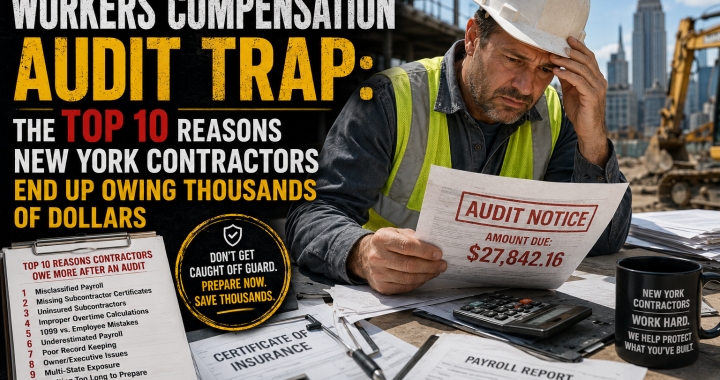
For many New York contractors, receiving a workers compensation audit notice can produce more anxiety than almost any other business document. A policy that began with an estimated premium of $15,000 can suddenly generate an additional bill for $25,000, $50,000, or even more after the annual audit is completed. Unfortunately, many contractors don’t discover their mistakes until the audit is finalized and payment is due.
Workers compensation audits are a normal part of doing business in New York construction, but they don’t have to become a financial disaster. Understanding the most common audit pitfalls can help contractors avoid costly surprises and better manage their insurance costs.
Below are the top ten reasons New York contractors find themselves owing thousands of dollars after their workers compensation audit.
1. Misclassifying Employee Payroll
One of the most common and expensive mistakes contractors make is placing employees in the wrong workers compensation classification codes.
For example, a contractor may classify an employee as a clerical worker when the employee regularly visits job sites. Others may improperly classify workers performing high-hazard activities under lower-rated classifications. During an audit, insurance companies review payroll records, job descriptions, and business operations to ensure classifications are accurate.
Even an honest mistake can result in substantial additional premium charges.
2. Failing to Obtain Certificates of Insurance From Subcontractors
Many contractors assume that because a subcontractor says they have insurance, everything is covered. Unfortunately, auditors require proof.
If a contractor cannot provide valid certificates of insurance and supporting documentation for subcontractors, the insurance company may include those subcontractor payments as payroll exposure. This can dramatically increase the audited premium.
Keeping current certificates of insurance on file throughout the policy period is one of the most important risk management practices any contractor can implement.
3. Using Uninsured or Underinsured Subcontractors
In New York, hiring uninsured subcontractors can create a financial nightmare. If the subcontractor lacks proper workers compensation coverage, the hiring contractor can become responsible for the exposure.
Auditors routinely review subcontractor payments, contracts, invoices, and certificates. Missing or inadequate coverage documentation can result in thousands of dollars in unexpected premium charges.
4. Improper Treatment of Overtime Payroll
Many contractors don’t realize that workers compensation rules generally allow the premium portion of overtime wages to be excluded from the audit calculation.
For example, if an employee earns time-and-a-half pay, the premium portion of that overtime may not be subject to workers compensation premium. However, contractors must maintain detailed payroll records separating regular and overtime wages.
Without proper documentation, auditors may include all overtime compensation, increasing the premium unnecessarily.
5. Paying Employees as Independent Contractors
Simply issuing a 1099 form does not automatically make someone an independent contractor.
New York applies strict standards when determining worker classification. If an auditor concludes that a worker classified as an independent contractor should actually be treated as an employee, the payroll associated with that worker may be added to the audit.
This issue frequently affects construction trades, trucking operations, and specialty subcontractors.
6. Underestimating Payroll at Policy Inception
Workers compensation policies are based on estimated annual payroll. If business grows significantly during the policy year, contractors can experience major audit adjustments.
While growth is usually a positive development, rapidly increasing payroll without notifying your insurance broker can create a substantial audit bill at the end of the policy period.
Regular communication with your insurance advisor can help prevent unpleasant surprises.
7. Poor Record Keeping
Incomplete payroll records are one of the biggest reasons contractors lose audit disputes.
Auditors typically review:
- Payroll journals
- Tax returns
- Quarterly payroll reports
- General ledgers
- Cash disbursement journals
- Subcontractor records
- Certificates of insurance
- Federal tax filings
When records are incomplete or inconsistent, auditors often apply the most conservative interpretation, which usually results in higher premiums.
8. Failing to Track Owners and Executive Exclusions Properly
New York workers compensation rules regarding business owners can be complicated.
Depending on the business structure, owners may or may not be included in workers compensation calculations. Improper handling of owner payroll, executive exclusions, or partnership structures can lead to costly audit adjustments.
Contractors should periodically review ownership status and exclusion forms with their insurance professional.
9. Misunderstanding Multi-State Operations
Many New York contractors perform work in neighboring states such as New Jersey and Connecticut. Different states have different workers compensation rules, classifications, and reporting requirements.
Failure to properly report out-of-state operations can create significant audit problems and potentially uninsured exposures.
Contractors performing work across state lines should ensure their policies are properly structured before beginning operations.
10. Waiting Until the Audit Notice Arrives
Perhaps the biggest mistake contractors make is preparing for the audit only after receiving the audit appointment letter.
Successful contractors prepare throughout the entire policy year. They maintain organized payroll records, collect subcontractor certificates immediately, monitor payroll changes, and consult their insurance advisor regularly.
Workers compensation audits should never be viewed as a once-a-year event. Instead, they should be considered an ongoing business management process.
Three Common Google Searches Contractors Use When Looking for Workers Compensation Help
When contractors begin experiencing workers compensation problems, they often search online using phrases such as:
- “How to reduce workers compensation costs for New York contractors”
- “Workers compensation audit help near me”
- “Best insurance broker for New York construction companies”
Understanding these issues before the audit occurs can save contractors thousands—or even tens of thousands—of dollars.
How BGES Group Can Help
BGES Group is a boutique insurance brokerage specializing in New York construction insurance and workers compensation programs. With more than 45 years of experience, we understand the unique challenges contractors face in New York’s demanding insurance environment.
We assist contractors with:
- Workers compensation program design
- Workers compensation audit preparation and review
- General liability insurance
- Umbrella liability coverage
- Pay-as-you-go workers compensation plans
- Construction risk management
- Subcontractor insurance compliance
- Builders risk insurance
- Commercial auto insurance
- Surety and bonding solutions
Unlike many large agencies where account managers may handle hundreds of accounts, BGES Group provides personalized service and direct access to experienced professionals who understand New York construction insurance.
If you’re concerned about an upcoming workers compensation audit, rising insurance costs, or gaps in your coverage program, we can help.
Contact BGES Group
Gary Wallach
Phone: (914) 806-5853
Email: bgesgroup@gmail.com
Website: BGES Group
Financial and Informational Disclaimer: This article is intended solely for general informational and educational purposes and should not be construed as legal, tax, accounting, or insurance advice. Workers compensation laws, classifications, and audit procedures vary based on individual circumstances and regulatory requirements. Contractors should consult qualified legal, accounting, and insurance professionals regarding their specific situations before making business or insurance decisions.