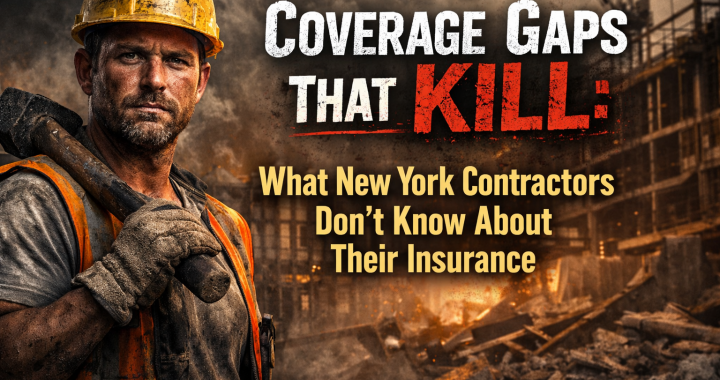
In New York’s high-risk construction environment, having insurance isn’t enough. What truly matters is what your policy actually covers—and what it doesn’t. Every year, contractors across the state discover too late that their insurance policies contain dangerous gaps, exclusions, or limitations that leave them fully exposed when a claim hits.
These aren’t small technicalities. These are the kinds of gaps that can turn a routine accident into a financial disaster.
If you’re a New York contractor, understanding these hidden dangers could be the difference between staying in business and shutting your doors.
The Illusion of Being “Fully Covered”
Many contractors believe that once they purchase a General Liability policy, they’re protected. Unfortunately, that assumption is often wrong.
Insurance policies today are filled with endorsements, exclusions, and conditions that dramatically change coverage. What looks like a standard policy on the surface may actually exclude the most common risks contractors face in New York.
This creates a dangerous illusion: you think you’re covered—until you’re not.
Labor Law Exclusions: The Biggest Hidden Threat
New York’s Labor Law (Sections 240 and 241) creates absolute liability for gravity-related injuries. These claims are among the most severe and expensive in the industry.
Here’s the problem:
Many insurance carriers now exclude Labor Law coverage entirely or severely limit it through endorsements.
That means:
- Falls from ladders or scaffolds may not be covered
- Gravity-related injuries could be excluded
- Legal defense may not be provided
Contractors often don’t realize this until after a claim is filed—and denied.
Without proper Labor Law coverage, one accident can lead to hundreds of thousands—or millions—of dollars in out-of-pocket costs.
Height and Gravity Exclusions
Even when Labor Law isn’t explicitly excluded, many policies include height limitations.
For example:
- No coverage for work above 2 or 3 stories
- Exclusion for exterior work
- Restrictions on roofing or façade work
If your business involves ladders, scaffolding, or elevated work (which most contractors do), these exclusions can completely wipe out your protection.
A contractor installing drywall on the third floor or repairing a roof may unknowingly be operating outside their coverage.
Subcontractor Warranty Clauses
If you use subcontractors, your policy likely includes a subcontractor warranty endorsement.
These clauses require you to:
- Obtain certificates of insurance from all subs
- Ensure subs carry specific limits
- Name you as an additional insured
- Use written contracts with indemnification language
If you fail to meet even one of these requirements, your insurance company may deny the claim entirely.
This is one of the most common—and devastating—coverage gaps in the industry.
Imagine this scenario:
A subcontractor causes an accident. You file a claim. The insurance company asks for documentation. One certificate is missing or expired.
Claim denied.
Additional Insured Misconceptions
Being named as an “additional insured” is often misunderstood.
Contractors assume:
- They are fully protected under another party’s policy
- Coverage is automatic and unlimited
In reality, additional insured coverage is:
- Limited to specific operations
- Subject to policy terms and exclusions
- Often restricted by endorsement language
If the endorsement is incorrect—or missing—there may be no coverage at all.
Even worse, many contracts require specific endorsements like:
- Primary and non-contributory wording
- Ongoing and completed operations coverage
If your policy doesn’t match the contract requirements, you could be in breach—and uninsured.
Residential and Roofing Exclusions
Another common issue in New York contractor policies is residential exclusions.
Some policies exclude:
- Work on single-family homes
- Renovations in apartments or condos
- Any residential construction activity
Others exclude roofing entirely, or only allow minor repairs.
If you’re doing residential work—even occasionally—you could be exposing your business to massive uninsured risk.
Late Notice of Claims
New York has strict requirements when it comes to reporting claims.
If you delay reporting an incident—even if it seems minor—the insurance company can deny coverage based on late notice.
This happens more often than you’d think:
- A worker gets injured but says they’re “fine”
- Weeks later, a lawsuit is filed
- The contractor reports it late
Result: Denied claim.
Proper claim reporting procedures are just as important as the policy itself.
Misclassification and Workers’ Comp Gaps
Workers’ compensation is another area filled with hidden risks.
Common issues include:
- Misclassifying employees as independent contractors
- Underreporting payroll
- Using uninsured subcontractors
If a worker is injured and your policy doesn’t properly cover them, you could face:
- Direct liability for medical costs
- State penalties and fines
- Stop-work orders
In some cases, the insurance company can even rescind your policy, leaving you completely exposed.
The Domino Effect of Coverage Gaps
One coverage gap rarely exists in isolation. They tend to stack.
A single claim can trigger multiple issues:
- Labor Law exclusion applies
- Subcontractor warranty not met
- Additional insured endorsement missing
Suddenly, you’re facing:
- No coverage
- Legal defense costs
- Settlement or judgment
This is how contractors go from profitable to bankrupt overnight.
Why This Problem Is Getting Worse
The insurance market for New York contractors has hardened significantly.
Carriers are:
- Adding more exclusions
- Tightening underwriting standards
- Increasing premiums
At the same time, lawsuits are increasing, and claim costs continue to rise.
This combination means contractors are paying more money for less coverage—and often don’t realize it.
The Solution: Proactive Risk Management
The only way to protect your business is to take a proactive approach.
That includes:
- Reviewing your policies in detail
- Understanding every exclusion and endorsement
- Ensuring contracts align with coverage
- Verifying subcontractor compliance
- Reporting claims immediately
Most importantly, it means working with someone who understands the unique challenges of New York construction insurance.
Don’t Let a Coverage Gap Destroy Your Business
At the end of the day, the biggest mistake a contractor can make is assuming their insurance will protect them—without verifying it.
At BGES Group, we specialize in helping New York contractors uncover and eliminate dangerous coverage gaps before a claim happens.
We work with contractors across all trades to provide:
- Labor Law coverage solutions
- Detailed policy reviews
- Contract and risk transfer guidance
- Workers’ compensation strategies
Our goal is simple: make sure your insurance actually works when you need it.
Contact BGES Group today:
- 📞 Gary Wallach: 914-806-5853
- 📧 Email: bgesgroup@gmail.com
- 🌐 Website: www.bgesgroup.com
Before your next job starts, take a closer look at your coverage. Because in New York construction, what you don’t know about your insurance can cost you everything.