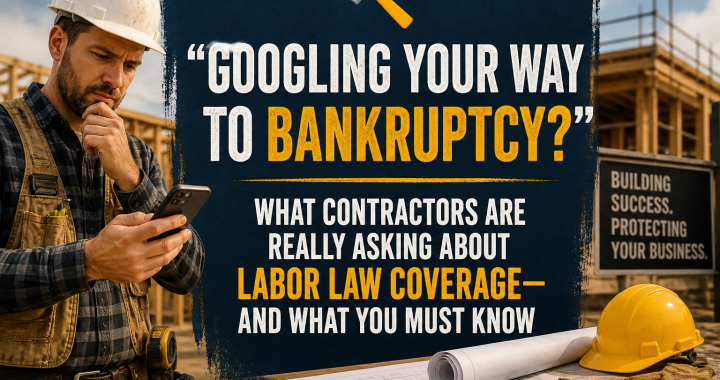
If you’re a contractor in New York, there’s a good chance you—or someone you know—has gone down the Google rabbit hole trying to understand labor law coverage. It usually starts after a claim, a contract rejection, or a shocking conversation with a general contractor or insurance broker.
The truth is, the questions contractors type into Google reveal a dangerous gap between what they think they’re covered for and what their policy actually says.
Let’s break down the 10 most common search phrases—and the critical truths behind them.
1. “Does general liability insurance cover labor law claims in New York?”
This is the most important question—and the most misunderstood.
Most standard General Liability (CGL) policies do NOT cover claims brought under New York Labor Law, especially sections 240 and 241. These laws impose absolute liability on contractors and property owners for gravity-related injuries (falls from heights, falling objects).
Translation: even if you did nothing wrong, you can still be held fully liable.
Without proper labor law coverage, your policy may leave you completely exposed.
2. “What is labor law coverage for contractors insurance NY?”
Labor law coverage is not a standard feature—it’s usually added through endorsements or specialized policies.
This type of coverage is specifically designed to protect contractors against claims arising from:
- Falls from ladders or scaffolds
- Falling debris
- Elevation-related injuries
If your policy doesn’t explicitly include it, you likely don’t have it.
3. “Do I need labor law 240 241 coverage in my CGL policy?”
If you work in New York—even occasionally—the answer is almost always yes.
General contractors and property owners routinely require proof of coverage for
- Labor Law 240 (Scaffold Law)
- Labor Law 241 (Construction safety)
Without it, you may:
- Lose jobs
- Breach contracts
- Be forced to indemnify others out of pocket
4. “Why is my liability insurance excluding labor law claims?”
Because many insurance carriers actively avoid this exposure.
Labor law claims in New York are expensive, unpredictable, and often catastrophic. Some carriers include exclusions like:
- “Action Over Exclusion”
- “Height Limitation Exclusion”
- “Labor Law Exclusion”
Contractors often don’t realize these exclusions exist—until it’s too late.
5. “Best insurance for contractors to cover labor law injuries NY”
This is where things get strategic.
Not all insurance companies are equal. Some carriers specialize in New York construction risks and offer:
- Proper labor law endorsements
- Higher risk tolerance
- Better claims handling
Choosing the wrong carrier just because it’s cheaper can cost you everything.
6. “Difference between general liability and labor law coverage construction”
Think of it this way:
- General Liability Insurance: Covers third-party bodily injury and property damage (e.g., you damage a client’s property).
- Labor Law Coverage: Protects you when a worker sues under New York’s strict labor laws—even if they weren’t your employee.
They are not the same—and confusing them is a costly mistake.
7. “How to get labor law coverage for scaffolding and falls NY”
You don’t just “add it on” like roadside assistance.
To obtain proper coverage, insurers typically evaluate:
- Type of work performed
- Use of ladders/scaffolding
- Safety protocols
- Loss history
- Subcontractor agreements
Many contractors are declined or heavily restricted because they don’t present themselves properly during underwriting.
8. “What insurance covers employee injury lawsuits against contractors NY?”
Here’s where things get tricky.
- Workers’ Compensation covers your employees’ injuries—but prevents them from suing you directly.
- However, under labor law, injured workers can sue property owners and general contractors, who then turn around and sue you.
This is known as a third-party action over claim—and it’s one of the biggest financial threats in construction.
9. “Why won’t my insurance cover construction accident lawsuits?”
Because of exclusions hidden in your policy.
Many contractors only look at the certificate of insurance—not the actual policy language. Unfortunately, certificates don’t show:
- Exclusions
- Limitations
- Endorsements
So when a claim happens, the denial letter becomes your first real look at your coverage.
10. “Contractor insurance that includes labor law 240 protection New York”
This is the holy grail—and it requires expertise.
Policies that truly provide meaningful protection often include:
- Labor Law 240/241 coverage
- Blanket additional insured endorsements
- Primary & non-contributory wording
- Waiver of subrogation
- Completed operations coverage
But these policies must be structured correctly from day one.
The Hard Truth: Most Contractors Are Underinsured
Here’s the uncomfortable reality:
Many contractors believe they’re covered—until a serious accident proves otherwise.
One fall. One lawsuit. One uncovered claim.
That’s all it takes to:
- Wipe out your business
- Destroy your reputation
- Put your personal assets at risk
Googling is a good start—but it’s not a strategy.
How BGES Group Helps Contractors Get It Right
At BGES Group, we specialize in construction insurance with a deep focus on New York labor law exposure.
We don’t just sell policies—we structure protection.
What We Do:
- Review your current insurance for hidden exclusions
- Identify labor law coverage gaps
- Place you with carriers that understand New York risk
- Help you meet strict contract requirements
- Guide you on subcontractor agreements and risk transfer
Why Contractors Work With Us:
- We understand the real-world risks—not just the paperwork
- We know which carriers will actually pay claims
- We help you avoid costly mistakes before they happen
Get Protected Before the Claim Happens
If you’re a contractor in New York and you’ve ever Googled any of these questions, it’s time to take the next step.
Let’s review your coverage and make sure you’re truly protected.
📞 Gary Wallach
📱 914-806-5853
📧 bgesgroup@gmail.com
🌐 www.bgesgroup.com
Don’t wait until a claim exposes the truth.
Know what you have—and more importantly, what you don’t.