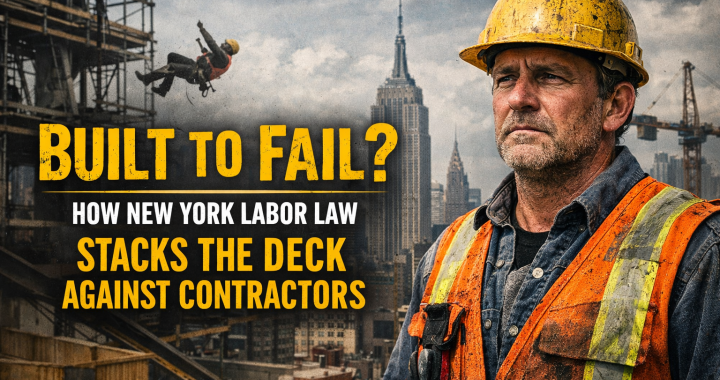
Construction is risky everywhere—but nowhere in the United States are contractors exposed to liability quite like they are in New York. The difference comes down to one word: liability. While most states follow a negligence-based system, New York operates under a unique and far more aggressive framework that can leave contractors financially responsible even when they did nothing wrong.
Understanding how Labor Law claims work in New York compared to states like New Jersey and Connecticut is essential for any contractor operating in the Tri-State area. The legal distinctions directly impact claims, lawsuits, insurance costs, and ultimately, the survival of a construction business.
The Foundation: How Most States Handle Construction Injury Claims
In states like New Jersey and Connecticut, construction injury claims generally follow a comparative negligence system. This means liability is based on fault.
If a worker is injured:
- The injured employee typically receives workers’ compensation benefits.
- Lawsuits against contractors or property owners require proof of negligence.
- Fault can be shared. If a worker is partially responsible, damages may be reduced accordingly.
For example, if a worker ignores safety protocols or misuses equipment, that behavior can significantly limit or eliminate the contractor’s liability.
This system creates a more balanced legal environment where responsibility is distributed based on actual conduct.
New York’s Game-Changer: Labor Law 240 & 241
New York flips this entire concept on its head.
Under Labor Law 240, commonly known as the “Scaffold Law,” contractors and property owners are held to a standard of absolute liability for gravity-related injuries.
This includes:
- Falls from heights (ladders, scaffolds, roofs)
- Falling objects striking workers
- Any elevation-related accident tied to inadequate safety protections
Here’s the critical difference:
👉 Fault does not matter.
If a worker is injured due to a gravity-related risk and proper safety devices were not in place—or are argued to be insufficient—the contractor can be held fully liable regardless of the worker’s actions.
Labor Law 241 expands exposure even further by requiring strict compliance with detailed construction safety regulations under the New York Industrial Code.
Absolute Liability vs. Negligence: The Core Difference
Let’s break it down clearly:
New York
- Absolute liability
- Worker fault is largely irrelevant
- Contractors and owners are often 100% responsible
- Lawsuits are common and severe
New Jersey / Connecticut
- Comparative negligence
- Fault is evaluated and shared
- Worker behavior matters
- Lawsuits are harder to win against contractors
This distinction is why New York is widely considered the most contractor-unfriendly legal environment in the country.
Real-World Claim Example
Scenario: Worker Falls from a Ladder
In New York:
- The worker falls from a ladder while installing ductwork.
- Even if the worker set the ladder incorrectly or ignored safety instructions, the contractor can still be held fully liable.
- Result: A high-value lawsuit under Labor Law 240.
In New Jersey or Connecticut:
- The same incident occurs.
- The court evaluates:
- Was the contractor negligent?
- Did the worker contribute to the accident?
- If the worker is 50% at fault, damages may be reduced or eliminated.
This single difference can mean the gap between a defensible claim and a catastrophic loss.
Why New York Claims Are So Expensive
Because of absolute liability, New York Labor Law claims:
- Are easier for plaintiffs to win
- Often result in larger settlements or verdicts
- Drive significantly higher insurance costs
Insurance carriers understand this exposure. As a result:
- Premiums in New York are dramatically higher than neighboring states
- Many insurers limit or avoid writing New York construction risks altogether
- Coverage often includes strict exclusions, especially for:
- Height-related work
- Labor Law claims
- Employee injury (“action over”) claims
In contrast, New Jersey and Connecticut contractors benefit from a more predictable risk environment, which leads to lower premiums and broader coverage availability.
The Insurance Impact: What Contractors Need to Know
For New York contractors, Labor Law exposure doesn’t just affect claims—it reshapes your entire insurance program.
Key Coverage Challenges in New York:
- Labor Law exclusions on general liability policies
- High umbrella/excess liability costs
- Limited carrier appetite
- Strict underwriting (height limits, trade restrictions, loss history scrutiny)
In New Jersey & Connecticut:
- More standard general liability policies
- Lower umbrella pricing
- Greater competition among carriers
- Fewer exclusions tied to worker injury claims
This is why two identical contractors—one in New York and one in New Jersey—can have dramatically different insurance costs and risk profiles.
The “Action Over” Problem
One of the most overlooked exposures in New York is the “action over” claim.
Here’s how it works:
- A worker is injured and collects workers’ compensation.
- The worker then sues the property owner or general contractor under Labor Law.
- The owner or GC turns around and sues the subcontractor (your company) for indemnification.
Because of Labor Law 240:
- These claims are extremely difficult to defend
- Subcontractors often get pulled into large lawsuits
- Contracts and insurance requirements become critical
This dynamic is far less common—and far less severe—in states like New Jersey and Connecticut.
Why This Matters for Contractors
If you are a contractor working in New York, you are operating in a fundamentally different legal environment than your peers across state lines.
Failing to understand this can result in:
- Uninsured claims
- Denied coverage
- Massive out-of-pocket losses
- Business-ending lawsuits
On the flip side, contractors who structure their insurance and contracts properly can:
- Transfer risk effectively
- Protect their balance sheet
- Compete more confidently in the market
Final Thoughts
New York Labor Law is not just another regulation—it is a game-changing liability framework that puts contractors at significant financial risk. While states like New Jersey and Connecticut rely on traditional negligence standards, New York’s absolute liability system creates a much harsher reality.
For contractors, the takeaway is simple:
👉 Where you work matters just as much as what you do.
About BGES Group
At BGES Group, we specialize in construction insurance for contractors operating in New York, New Jersey, and Connecticut. We understand the complexities of Labor Law exposure and how it impacts your general liability and umbrella programs.
We work with top-rated carriers to:
- Navigate Labor Law coverage challenges
- Structure policies that protect against catastrophic claims
- Identify and eliminate dangerous coverage gaps
- Provide strategic guidance tailored to your trade and operations
Whether you are facing rising premiums, non-renewals, or coverage restrictions, we can help you secure the protection your business needs.
Contact Information
Gary Wallach
📞 914-806-5853
📧 bgesgroup@gmail.com
🌐 www.bgesgroup.com