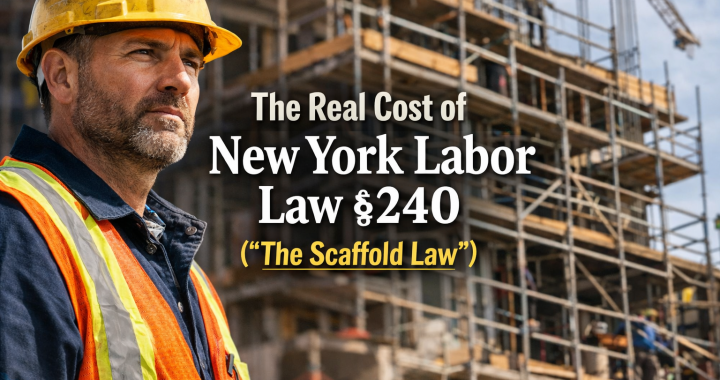
In the world of New York construction, few laws carry more weight—or more financial risk—than New York Labor Law §240, commonly known as the “Scaffold Law.” While many contractors have heard of it, far fewer truly understand how devastating its impact can be on their business. Misunderstanding this law is one of the most expensive mistakes a contractor, subcontractor, or property owner can make.
At its core, Labor Law §240 was designed to protect workers from gravity-related injuries, such as falls from heights or injuries caused by falling objects. On its face, that seems reasonable. But the way the law is applied in New York courts is what makes it uniquely dangerous from a liability and insurance standpoint.
Absolute Liability: The Game Changer
Unlike most liability laws, Labor Law §240 imposes what is known as absolute liability on owners and general contractors. This means that if a worker is injured due to a gravity-related hazard, the owner or general contractor can be held fully liable—regardless of whether they were actually negligent.
Let that sink in.
Even if:
- The contractor provided proper safety equipment
- The worker was trained
- The accident was partially or entirely the worker’s fault
…the owner and/or general contractor can still be found 100% liable under §240.
This is a major departure from standard negligence principles, where fault is typically shared. In most other states, comparative negligence would apply, reducing damages based on the injured party’s responsibility. In New York, under §240, that defense is extremely limited.
The Types of Claims That Trigger §240
Labor Law §240 applies specifically to gravity-related risks. Some of the most common claim scenarios include:
- Falls from ladders or scaffolds
- Falls from roofs or elevated surfaces
- Injuries from collapsing structures
- Being struck by falling tools, materials, or debris
What makes these cases especially costly is not just the severity of the injuries—but the legal framework that virtually guarantees recovery for the injured worker if a violation is found.
Why These Claims Become So Expensive
The financial exposure tied to §240 claims is enormous. Serious construction injuries often involve:
- Traumatic brain injuries
- Spinal cord injuries
- Permanent disability
- Lost wages over a lifetime
When you combine these damages with absolute liability, settlements and verdicts frequently reach into the millions—and sometimes tens of millions—of dollars.
Defense costs alone can be staggering. Even when a case is defensible on the facts, the legal burden created by §240 makes it extremely difficult to win outright. As a result, many cases are settled simply to control risk.
The Insurance Problem: Coverage Isn’t Always Enough
Many contractors assume that having a Commercial General Liability (CGL) policy means they are protected. Unfortunately, that is not always the case.
Here’s where things get complicated:
- Policy limits may be inadequate for large §240 losses
- Exclusions and endorsements may restrict coverage
- Deductibles or self-insured retentions (SIRs) can be substantial
- Umbrella policies may not follow form as expected
In addition, the structure of construction contracts often pushes liability downstream—creating a complex web of insurance obligations between owners, general contractors, and subcontractors.
The Role of Risk Transfer
Because of the severity of Labor Law §240 exposure, risk transfer becomes critical. This is where many contractors either protect themselves—or unknowingly expose themselves.
Effective risk transfer involves two key components:
1. Contractual Indemnification
A properly drafted indemnification agreement requires subcontractors to assume responsibility for certain claims, including those arising from their work. However, these agreements must comply with New York’s anti-indemnity statutes and be carefully worded to be enforceable.
2. Additional Insured Coverage
Requiring subcontractors to name the general contractor and owner as additional insureds on their liability policies is essential. But not all additional insured endorsements are created equal.
Key issues include:
- Whether coverage applies to ongoing and completed operations
- Whether coverage is primary and non-contributory
- Whether the policy actually responds to Labor Law claims
Too often, contractors rely on certificates of insurance without verifying the actual policy language—only to discover gaps after a claim occurs.
The Subcontractor Trap
One of the biggest exposures under §240 comes from subcontractors. If a subcontractor’s employee is injured, that employee typically cannot sue their employer due to workers’ compensation laws. However, they can—and often do—sue the owner and general contractor under Labor Law §240.
From there, the claim often comes full circle:
- The owner/GC is held liable under §240
- They seek indemnification from the subcontractor
- The subcontractor’s insurance is triggered
If the subcontractor does not have proper coverage, or if the risk transfer mechanisms are flawed, the financial burden can fall back on the general contractor—or even their own insurance program.
Real-World Consequences
Contractors across New York have faced:
- Policy cancellations following large losses
- Skyrocketing insurance premiums
- Difficulty obtaining umbrella coverage
- Increased scrutiny from carriers
In some cases, a single §240 claim has put companies out of business.
This is not theoretical risk—it is a daily reality in the New York construction market.
How Contractors Can Protect Themselves
While Labor Law §240 cannot be avoided, its impact can be managed with the right strategy.
Key steps include:
- Review all contracts carefully to ensure proper indemnification language
- Standardize subcontractor insurance requirements
- Verify additional insured endorsements—not just certificates
- Maintain adequate liability and umbrella limits
- Work with brokers who specialize in construction risk
- Implement strong safety protocols and documentation practices
Just as important is understanding that insurance is not just a commodity—it is a critical component of your overall risk management strategy.
Final Thoughts
Labor Law §240 remains one of the most powerful—and controversial—laws affecting the construction industry in New York. While its intent is to protect workers, its application creates significant financial exposure for contractors, owners, and insurers alike.
Understanding how this law works, and more importantly how it impacts your insurance program, is essential to protecting your business. The difference between being properly structured and improperly exposed can mean the difference between surviving a claim—or not.
BGES Group is a leading Construction Insurance specialist serving New York, New Jersey, and Connecticut. We represent over 25 top-rated insurance carriers, providing access to the best general liability and umbrella liability programs available. Our comprehensive coverage options include property, builders’ risk, inland marine, general liability, umbrella liability, commercial auto, bid and performance bonds, workers’ compensation, New York State disability, and group health. Beyond offering policies, we pride ourselves on being highly accessible—by call, text, or email—even on weekends—so you always have a trusted partner to help you navigate any insurance challenge.
We are also Workers’ Compensation specialists for tri-state business owners. Whether you are dealing with high premiums, policy cancellations, difficulty obtaining coverage due to losses, audit disputes, or payroll misclassification issues, we can help. We offer specialized programs for industries including auto services, contractors (especially in New York), limousine services, logistics companies, manufacturers, recyclers, and trucking operations. As a “Preferred Agent” for a select workers’ compensation program, we can often secure highly competitive pricing, long-term stability, and multi-state coverage for qualified clients—while also simplifying the audit process and reducing the burden of annual audits.
Contact Us:
Gary Wallach
Phone: 914-806-5853 (Direct)
Email: bgesgroup@gmail.com
Website: www.bgesgroup.com
Office Location:
216A Larchmont Acres West
Larchmont, NY 10538